

Ask ten people how they save and nine will say some version of "whatever is left at the end of the month." Then ask how much was left last month. The answer is usually a laugh.
Nothing is left because spending expands to fill the account. That is not a character flaw. It is how an account with one number in it works: the number looks like permission. The fix is not more discipline. It is moving the savings out before the number ever shows up, so the account you spend from is already smaller and your brain adjusts to that without a fight.
This is the setup we use and recommend. It takes about twenty minutes, it works with any bank, and once it is running you never decide to save again. It just happens.
The order matters: save first, then bills, then everything else
Most advice says "pay yourself first" and leaves it there. In practice the order on payday should be:
- Savings leaves on payday, automatically.
- The bills share moves to your bills account, automatically. (If you don't have a bills account yet, this guide sets it up.)
- What's left in your everyday account is yours to spend until the next paycheck, and you can spend it without guilt, because the saving already happened.
The third point is the one people underrate. A savings system that leaves you feeling broke all month will be abandoned by March. The point of automating it is that the rest of your money becomes genuinely free to enjoy.
How much to start with
Less than you think, then more over time. The number that matters at the beginning is not the amount, it is that the transfer runs every single payday without you touching it.
Our suggestion: start at 5% of take-home pay if money is tight, 10% if it is manageable, and raise it by one percentage point every three months until it hurts a little, then stop there.
For someone taking home $1,850 every two weeks:
| Rate | Per paycheck | Per year | Notice it? |
|---|---|---|---|
| 5% | $92.50 | $2,405 | Barely |
| 10% | $185.00 | $4,810 | A little |
| 15% | $277.50 | $7,215 | Yes, and worth it |
| 20% | $370.00 | $9,620 | A real change |
Two things jump out. First, 5% feels like nothing per paycheck and is still $2,400 in a year, which is more emergency fund than most people have. Second, each step up is only about $92 a paycheck, which is one fewer takeout week. Raising it slowly is how you get to 15% without ever feeling a jump.
The paycheck splitter has a savings slider so you can see the per-paycheck and yearly number for your own pay in a few seconds.
Where the money should go
A savings account at a different bank from your checking. Not the one your debit card is attached to. The small delay of moving money back (usually one to three days between banks) is a feature. It is just enough friction to stop a Tuesday-night impulse without stopping a real emergency.
Pick a high-yield savings account. Rates move, but at the time of writing many online banks pay around twenty times what a big-bank savings account pays, with no fees and no minimum. On $5,000 that is the difference between a few dollars a year and a couple of hundred.
Then name the account. "Savings" is forgettable. "3 months of expenses" or "Car in 2028" is a reason. Most banks let you rename accounts in the app, and some let you open several named sub-accounts for free. Name every goal.
How to make it automatic (two ways, use the stronger one if you can)
Option A: split your direct deposit at work. This is the strongest version because the savings never passes through your checking at all. Your HR portal or payroll form usually has "add an account" with a dollar amount or percentage. Put your savings account there with your number. You will forget it exists, which is exactly the point.
Option B: a recurring transfer the day after payday. If you can't split direct deposit (gig work, some small employers), set a repeating transfer in your bank app from checking to savings for the same amount, scheduled for the day after each payday. The day after, not the day of, so a late deposit never causes an overdraft.
Either way, write the number down somewhere you'll see it in three months, with a note: "raise by 1%."
Give the money a job, in this order
Automatic saving with no target leaks. You need one named goal at a time:
- A one-month cushion: $1,000 or one month of bills, whichever is smaller. This is the "car battery died" fund. It stops small surprises from becoming credit card debt.
- One to three months of expenses. Not income, expenses. If your bills and groceries come to $2,800 a month, three months is $8,400. It sounds far away; at 15% of our example paycheck it is about fifteen months of transfers. Work toward one month first, celebrate, then keep going.
- Then the fun goals. The trip, the car, the move. Open a separately named account for each so the emergency money and the vacation money never blur.
If you have credit card debt at 20%+, put most of the "extra" toward that after the one-month cushion exists. Saving at 4% while paying 24% is losing money, but having no cushion at all is how the debt grows back. Do the cushion, then the card.
The two tricks that add up quietly
The leftover sweep. The night before payday, whatever is left in your everyday account above a small floor (say $50) goes to savings. Some banks can do this automatically; otherwise it is a 30-second habit. It turns "I didn't spend it all" into savings instead of into next week's extra.
The third paycheck. If you are paid every two weeks, two months a year have three paydays. Your bills are already covered by the regular transfers, so most of that third check is free. Decide in advance that it goes to the current goal. Two of those a year at our example pay is about $1,700 you'd otherwise never see again.
If your income is irregular
Save a percentage, not an amount. A fixed $185 transfer overdrafts in a slow month and under-saves in a good one. Pick 10% of whatever arrives and move it the day it lands. It takes thirty seconds and it scales with your life. When income is lumpy, the one-month cushion in step one above matters even more, because it is what smooths the gaps between payments.
When you have to dip into it
You will. That is what it's for. The two rules that keep it from falling apart:
- Take it from the right pot. A car repair comes from the cushion, not the vacation account. Named accounts make this automatic.
- Don't pause the transfer. The instinct after a withdrawal is to "catch up" by stopping saving for a bit. Keep the transfer running at the same number and let the account refill on its own. Pausing is how most automatic plans quietly end.
How Elena does this
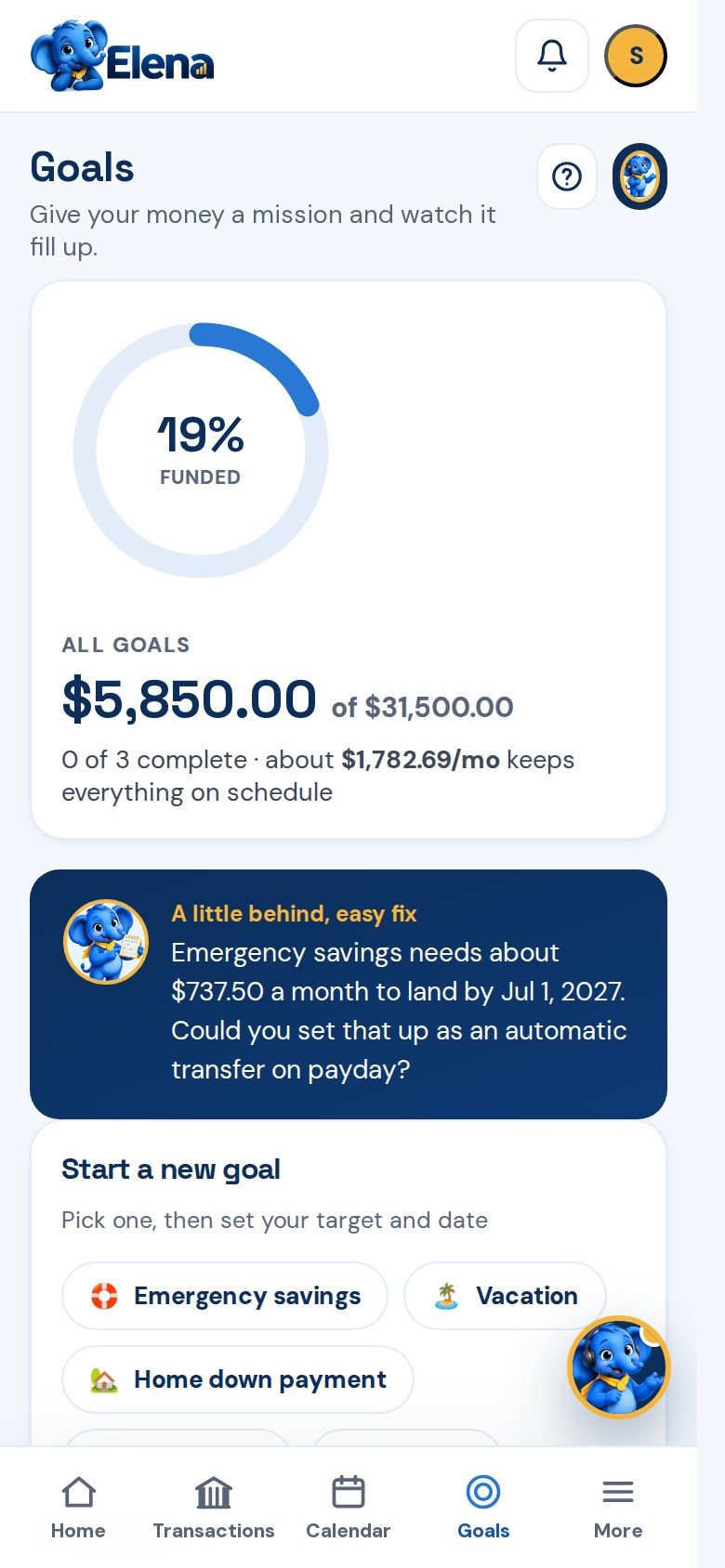
We built Elena's Goals around the same idea, because the hardest part of saving is seeing progress.
- Add a goal, pick a target and a date, and Elena tells you the amount per paycheck that gets you there.
- Link the goal to your savings account (read-only, through Plaid) and the progress ring updates by itself every time a transfer lands. No typing.
- Ask her "how much should I save each paycheck for the trip?" and she answers with your real numbers.
- The Budget tab shows savings as its own bucket, so you can see this month's transfers already counted before you look at what's left to spend.
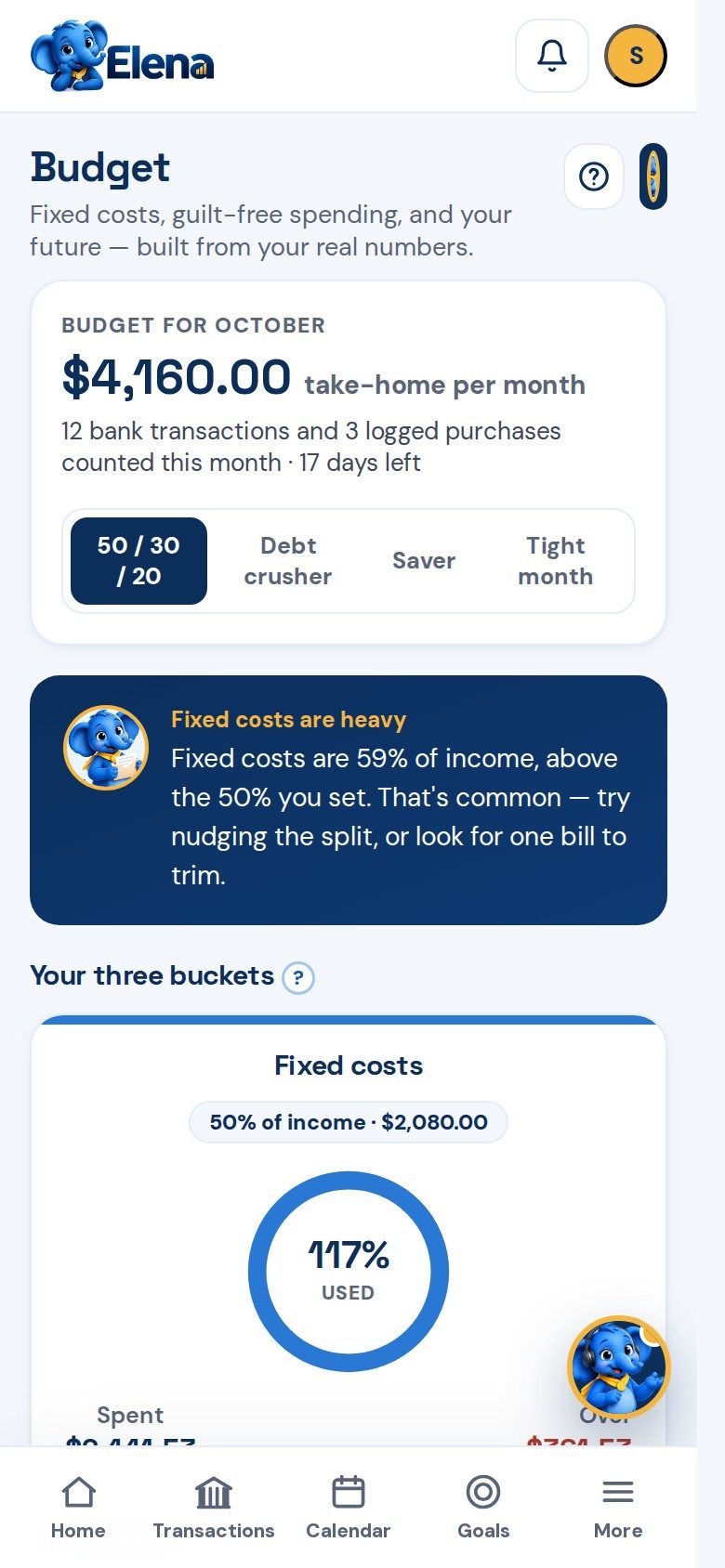
None of this needs Elena to work. A split direct deposit, a named account at another bank and a note to raise it by 1% will get you most of the way. Elena just makes it visible, which, in our experience, is what keeps people going past month three.