

If you get paid every other Friday and your rent is due on the 1st, you already know the feeling. Some months the 1st lands right after payday and everything is fine. Other months it lands eleven days after, your account is thin, and you are doing math in the grocery line to figure out whether the phone bill can wait.
Nothing is wrong with you. The problem is a calendar problem: bills run on months, paychecks run on weeks, and 26 paychecks do not divide into 12 months. This guide walks through the fix we use ourselves and built into Elena. It is boring, it takes one evening to set up, and after that the question "which paycheck pays rent?" goes away for good.
Why "half my bills from each paycheck" doesn't work
The natural move is to split the month's bills across the two paychecks in that month. It feels fair and it fails in a predictable way, because you don't get two paychecks a month. You get 26 a year, which is two a month for ten months and three in the other two.
So in a "two paycheck" month you are short, and in a "three paycheck" month you feel rich and spend the extra. By the next tight month the cushion is gone. The fix is to stop thinking in months at all.
The rule: every paycheck carries one twenty-sixth of a year of bills, not half a month of bills.
That one change is the whole method. Everything below is just making it automatic.
Step 1: write down every bill with its real due date
Not from memory. Open your bank app, scroll back 60 days, and list everything that comes out on a schedule. People forget the annual ones (car registration, the $120 Amazon renewal) and the quarterly ones (water, trash), and those are exactly the bills that ambush you.
Here is a real-looking list for someone taking home $1,850 every two weeks:
| Bill | Amount | Due | How often |
|---|---|---|---|
| Rent | $1,250 | 1st | Monthly |
| Car payment | $310 | 15th | Monthly |
| Car insurance | $138 | 22nd | Monthly |
| Phone | $72 | 9th | Monthly |
| Electric | $95 (varies) | 18th | Monthly |
| Internet | $65 | 3rd | Monthly |
| Credit card minimum | $75 | 27th | Monthly |
| Streaming and gym | $45 | various | Monthly |
| Water and trash | $100 | 10th | Every 3 months |
| Car registration | $160 | March | Yearly |
Add them up as a monthly number. Quarterly bills count as one third per month (water: $33), yearly bills as one twelfth (registration: $13). This list comes to about $2,096 a month. Round up to $2,150 so the "varies" bills have room. Rounding up is not optional. The method only works if the bills account never runs dry.
Step 2: turn the monthly total into a per-paycheck amount
This is the only math in the whole thing.
| Paid | Paychecks a year | Formula | For $2,150 of bills |
|---|---|---|---|
| Weekly | 52 | bills × 12 ÷ 52 | $496.15 per paycheck |
| Every 2 weeks | 26 | bills × 12 ÷ 26 | $992.31 per paycheck |
| Twice a month | 24 | bills × 12 ÷ 24 | $1,075.00 per paycheck |
| Monthly | 12 | bills × 12 ÷ 12 | $2,150.00 per paycheck |
Notice the biweekly number, $992.31, is less than half of $2,150. That is the 26-vs-24 difference showing up as real money: about $83 a paycheck that the "half the bills" approach was over-taking from you in tight months and handing back in the lucky ones.
If you want this done for you, the paycheck splitter does exactly this calculation and also shows what is left to spend and save.
Step 3: open a second checking account, just for bills
One account for bills, one for everything else. Most banks let you open a second checking account in about five minutes in the app, and many credit unions give you one for free. Name it something blunt. Ours is literally called "Bills autopay only."
Then move every autopay to that account: rent, car, insurance, phone, the lot. From this point on, nothing comes out of your everyday account on a schedule. Your everyday balance is finally what it looks like: money you can spend.
Why a separate account and not a budgeting category? Because categories are a promise and accounts are a fact. If the money is sitting in the account you swipe from, a hard week will spend it. If it is in an account you never carry a card for, it stays put.
Step 4: set up an automatic transfer every payday
In your bank app: recurring transfer, from everyday checking to bills checking, $992.31 (your number), every two weeks on payday. If your employer lets you split direct deposit, do that instead and the money never even touches your everyday account.
That's the setup. Every payday the bills account grows by the same amount, and every due date the autopay takes what it needs. You do not touch it, think about it, or time it.
Step 5: build the cushion, because month one is the hard one
Here is the part most guides skip. On the day you start, the bills account is empty, and rent is due on the 1st whether the account is ready or not. The transfers only cover bills evenly over time; they don't cover the first few weeks.
You need a cushion in the bills account of roughly half a month of bills. For our example that is about $1,075. Three ways to get there, slowest to fastest:
- Ramp up. Keep paying bills from your everyday account for one more month while the transfers build the balance. Messy, but no extra money needed.
- Use the next third-paycheck month. Twice a year you get a paycheck with no new bills attached. The whole thing goes into the bills account as cushion. If one is coming in the next couple of months, this is the cleanest route.
- Tax refund or a bonus. Boring, effective.
Once the cushion is there, the account hovers between about $1,000 and $2,100 all year, and a bill due three days before payday is just a normal Tuesday.
What to do about the bill that lands before payday
Even with a cushion, people ask about the specific bill that is due the day before the money arrives. Three fixes, in order:
- Move the due date. Phone, internet, car insurance and most credit cards will move your due date if you call or change it in the app. Push the early-month bills to the 5th or later and the problem mostly disappears.
- Pay it early on purpose. The bills account has the cushion. Paying the phone bill five days early from the bills account changes nothing about your month.
- For rent, ask once. Landlords often accept the 3rd or 5th if you ask before you're late and pay reliably after. The worst answer is no.
The two extra paychecks a year
If you are paid every two weeks, two months each year contain three paydays. Which months depends on your pay schedule. For someone paid on Fridays starting January 9, 2026, the three-payday months are May and October. Look at your own calendar and mark them.
With this method, those third paychecks still send $992.31 to bills (the yearly math already counted them). The other $858 is the most honest "free money" you will see all year. Decide now what it does: cushion first, then the emergency fund, then a goal. Deciding in advance is the difference between building something and wondering where it went.
Mistakes we see over and over
- Rounding down. A $95 electric bill that hits $140 in August drains the account. Round the monthly total up, always.
- Keeping a debit card for the bills account. It becomes an everyday account within a month. No card, no ATM access, nothing.
- Forgetting the yearly bills. Car registration, Amazon, insurance paid annually, the $200 school fee. They belong in the monthly total at one twelfth each.
- Counting groceries as a bill. Groceries and gas are spending, not bills. Keeping them out keeps the bills number stable and the spending account honest.
- Not updating the number. Rent goes up, you add a subscription. Recalculate once a quarter. It takes two minutes with the splitter.
How Elena handles all of this
We built Elena around this method because we were tired of the spreadsheet.
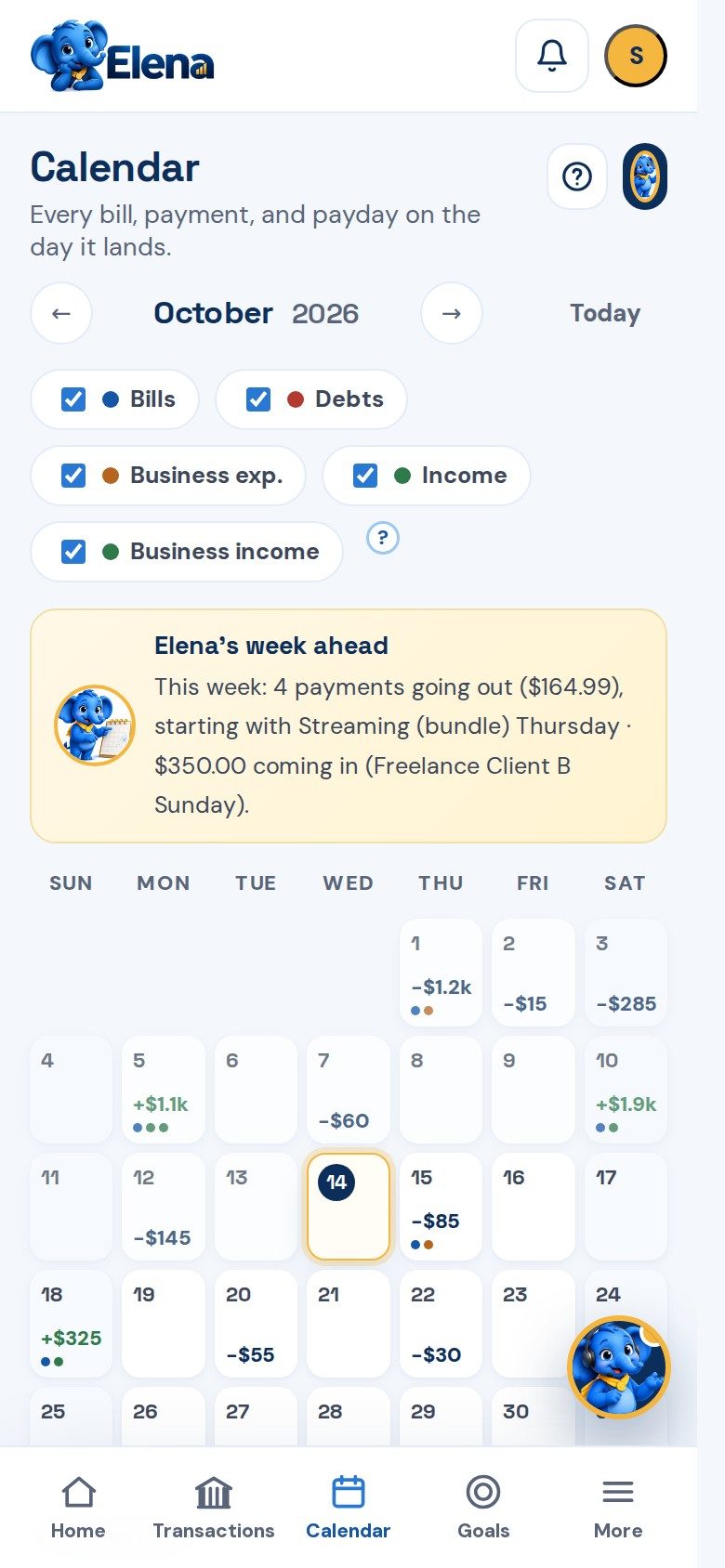
- You add each bill once (amount, due date, how often). Elena puts every due date on a calendar, including the quarterly and yearly ones, and counts down to each.
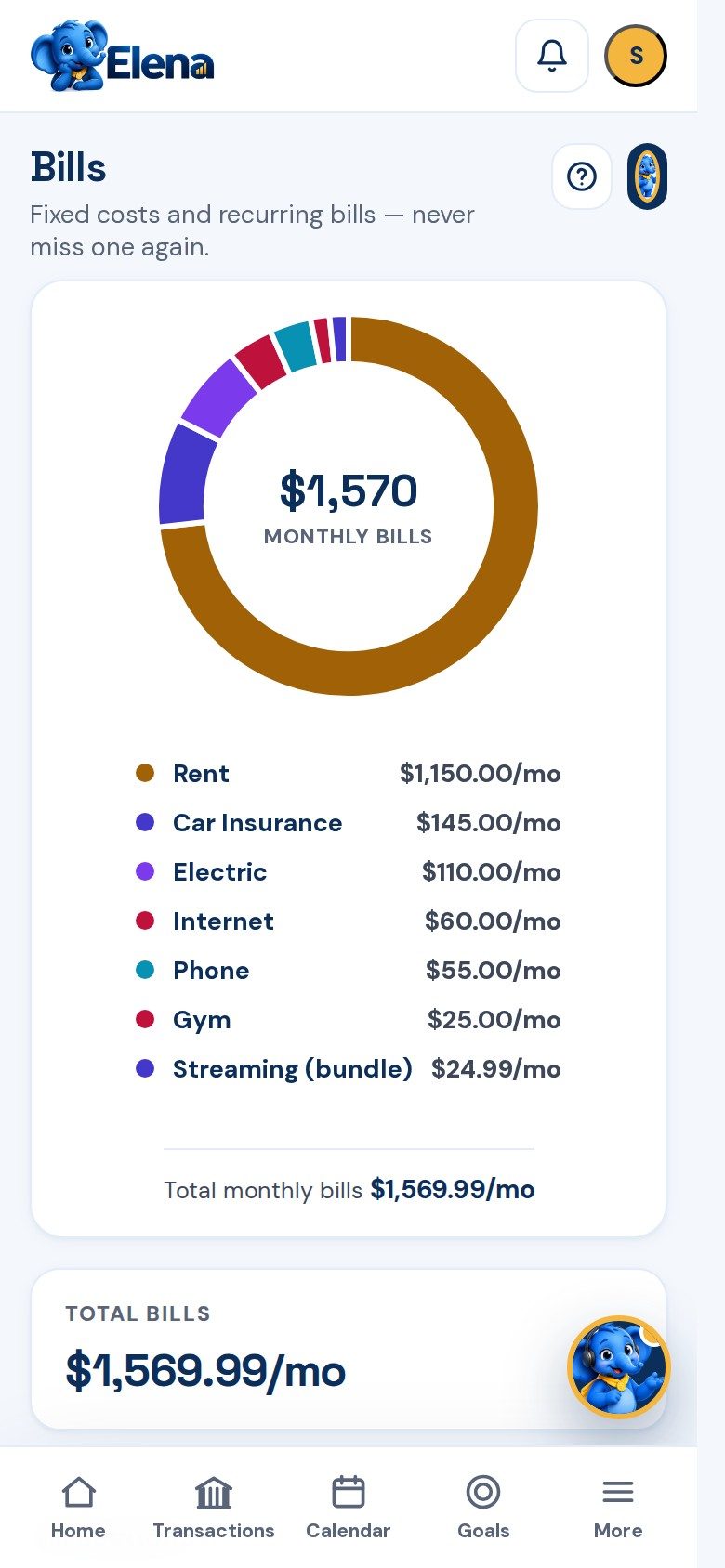
- The Bills tab shows the recommended transfer per paycheck, weekly, every two weeks or monthly, already rounded up with room for the bills that vary.
- Connect your bank (read-only) and Elena marks bills as paid when the payment clears, and tells you three days before anything is due.
- Ask her "what's due this week?" and she answers with the real amounts.
If you'd rather do it by hand, everything above works with any bank and a free second checking account. Either way, the goal is the same: never again wonder which paycheck pays rent.